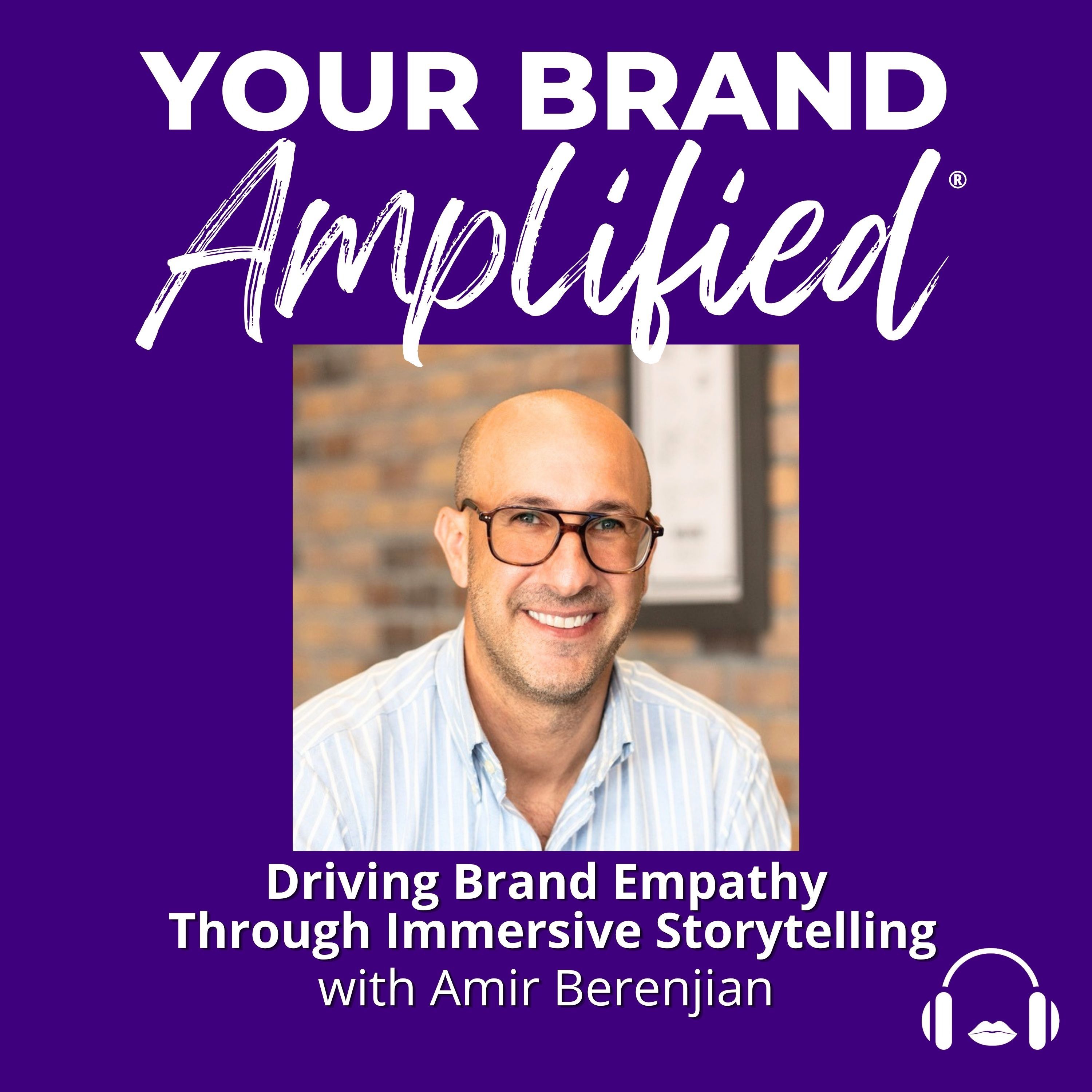
August 5, 2026 · 48 min · Episode 766
Driving Brand Empathy Through Immersive Storytelling with Amir Berenjian
About this episode
Anika sat down with Amir Berenjian to explore how a former investment banker transitioned from multi-million dollar M&A spreadsheets to founding an immersive technology company. The conversation revealed a profound truth: the most powerful way to sell a brand or cause isn't through data alone, but through deeply emotional, shared experiences. Amir shares how REM5 Studios leverages virtual reality (VR) to transport trade show attendees to a Wisconsin dairy farm and global policymakers to the frontlines of polio eradication in Zambia, proving that immersive tech is far more than just a novelty.
In This Episode
- How 12 years in M&A investment banking prepared Amir for immersive storytelling
- The pivotal moment of trying the Oculus Rift in 2016 and seeing the future of human-computer interaction
- Using pizza and beer to overcome VR skepticism in the corporate world
- Why the ROI of immersive tech at trade shows vastly outperforms traditional marketing trinkets
- Transporting global policymakers to Zambia to fight polio via VR with the Gates Foundation
- How a premium cheese brand uses VR to tell the story of a 100-year-old family farm
- The surprising dual-use of VR for both external marketing and internal employee onboarding
- How to test out immersive tech for your brand without breaking the budget
Timestamps
- 00:00 Introduction: From investment banking to immersive tech
- 02:09 The surprising emotional throughline between M&A banking and VR storytelling
- 04:38 The Oculus Rift "Aha!" moment and democratizing the "magic school bus" experience
- 07:35 Overcoming the VR accessibility barrier and corporate skepticism
- 11:13 Transitioning from corporate events to purpose-driven storytelling and global causes
- 13:33 The economics of immersive tech and why it's cheaper than you think
- 15:08 Dominating trade shows: Why shared VR experiences beat traditional marketing flyers
- 17:29 Case Study 1: Transporting customers to a 3rd-generation Wisconsin dairy farm
- 19:38 Case Study 2: Putting policymakers on the frontlines of polio with the Gates Foundation
- 20:23 How immersive 3D video actually works (and the nostalgia of the View-Master)
- 25:13 The 9-month planning process and why distribution is the biggest hurdle in VR
- 29:39 The intersection of AI, implicit bias, and leveraging technology for good
- 31:47 Measuring the impact and ROI of immersive storytelling
- 34:33 How small businesses can test the waters of VR for under $500
- 38:33 The dual value of VR: Using marketing tools for internal employee onboarding
- 41:42 What’s next for REM5 Studios and the convergence of AI and spatial computing
Key Insights & Takeaways
Insight 1: M&A and VR are Both About Selling Emotion
Even in investment banking, multi-million dollar deals are driven by the emotional story of a business. Amir realized VR is simply the ultimate tool for democratizing that story, allowing clients to "tour the factory" and meet the founders without ever leaving the boardroom.
Insight 2: Immersive Tech Solves the Trade Show ROI Problem
Trade shows are filled with expensive, easily discarded trinkets and flyers. Immersive tech completely steals the show by giving attendees a shared, memorable experience that re-energizes them. Because the experience can be reused across dozens of events, it proves to be far more cost-effective and impactful than traditional trade show marketing waste.
Insight 3: The Technology is the Conduit, Not the Message
People easily get caught up in buzzwords like AR, VR, and spatial computing. But the goal isn't to talk about the tech—it's to use the tech to tell a story so effectively that users forget they're wearing a headset. Whether it's understanding the reality of polio eradication or the care behind a premium cheese, the tech is just a vehicle for presence and empathy.
Insight 4: Marketing Assets Make Perfect Internal Training Tools
An immersive experience originally designed to sell a product to consumers can instantly be repurposed as an onboarding tool for HR and accounting teams. Giving new or remote employees a virtual factory tour accelerates learning, reduces training costs, and emotionally connects desk workers to the company’s physical roots.
Insight 5: You Can Test VR for Your Business on a Budget
You don't need a massive corporate budget to start experimenting with immersive storytelling. With a $400 Meta Quest headset or a free 30-minute demo at an Apple Store, business owners can experience existing VR content, identify use cases, and understand the medium before ever committing to a custom build.
Resources & Links Mentioned
REM5 Studios
Polio's Last Mile (VR Experience available on Meta Quest & Apple Vision Pro)
Meta Quest 3 / Apple Vision Pro
About Amir Berenjian
Amir Berenjian is the co-founder and CEO of REM5 Studios, an immersive technology company based in Minneapolis that builds virtual and augmented reality experiences for brands and causes. Before transitioning to spatial computing, Amir spent 12 years in investment banking, facilitating over 100 M&A transactions for companies ranging from $10 million to over $1 billion in revenue. Today, he helps organizations like the Gates Foundation, Rotary International, and Fortune 500 companies leverage the power of VR to foster profound empathy, connection, and real-world impact.
Connect with Amir
LinkedIn: https://www.linkedin.com/in/amir-berenjian-90738220/
Website: REM5Studios.com
YBA was named the top PR podcast in the US by FeedSpot! Feedspot is an RSS Reader that lets you follow your favorite podcasts alongside blogs and news in one place.
Like the show? Leave us a rating or review: https://lovethepodcast.com/67940257010b317cdaa9d857
Send us a Message: https://podcastfeedback.com/67940257010b317cdaa9d857
Check out our Website: https://www.yourbrandamplified.com
Speak to my Delphi Clone: https://www.delphi.ai/amplifywithanika
Hosted by Simplecast, an AdsWizz company. See pcm.adswizz.com for information about our collection and use of personal data for advertising.
Article
Amir Berenjian on Building Brand Empathy With Immersive VR Storytelling
Amir Berenjian is the co-founder and CEO of REM5 Studios, an immersive technology studio, and spent 12 years in mergers and acquisitions before that. On Your Brand Amplified, he talks with Anika Jackson about how virtual reality creates shared emotional experiences that move people to act, for brands, nonprofits and internal teams. His view: the technology is the conduit, not the message.
Why did Amir Berenjian move from M&A to virtual reality?
Because he saw that deals were won through narrative, not spreadsheets. In mergers and acquisitions, selling a family business or securing investment meant helping stakeholders see a future. When Amir Berenjian tried the Oculus Rift in 2016, he saw a way to give anyone that experience, not just people in boardrooms. He calls it a "magic school bus" moment: technology that can take anyone anywhere and change how they understand the world.
How do you get skeptics to try VR?
Remove the friction. In REM5 Studios' early years, Amir found the barrier was psychological, not technical; many people saw VR as a gaming novelty. What worked was pizza, beer and easy ways to try it. The people most taken with it were often the ones who had written it off. Once inside a headset, skeptics changed their minds.
Why does immersive storytelling build empathy?
Because presence changes perception. As Amir Berenjian puts it, wine tastes better at the vineyard. People remember spatial experiences more vividly than flat media, and that memory drives empathy and action.
He doesn't measure success by mass reach. A trade show experience might reach about 1,500 people over five days, and those people leave changed. The method is the same whether REM5 is taking global policymakers to the frontlines of polio eradication in Zambia or trade show visitors to a Wisconsin dairy farm behind a premium cheese brand. Nonprofits and purpose-led organizations, including the Gates Foundation and Rotary International, came to REM5 because a mission's emotional weight doesn't come through in PowerPoint. Their budgets are smaller than Fortune 500 budgets, but the fit between medium and message produces belief.
How can companies use immersive content internally?
For onboarding and training, which Amir Berenjian says most organizations underuse. The experience that convinces customers can speed up onboarding, shorten training (from twelve months to six in one example he shares) and connect desk workers to a company's physical roots. A cheese maker's marketing film becomes an employee orientation tool. A polio documentary becomes training for new health workers.
He expects AI and immersive technology to converge and is mindful of the risks: privacy, bias and manipulation. His motto is "just be curious," and starting doesn't take a big budget:
- Try a demo of existing content, such as a free 30-minute session at an Apple Store.
- Consider an entry-level headset like the roughly $400 Meta Quest.
- Explore experiences such as Polio's Last Mile on Meta Quest and Apple Vision Pro for ideas for your own brand.
Key takeaways
- The barrier to VR adoption is psychological; lowering friction converts skeptics.
- Spatial experiences are remembered more vividly than flat media, which builds empathy.
- Depth of impact on a small audience can matter more than mass reach.
- Reuse immersive content internally; one example cut training from twelve months to six.
- Start small with an in-store demo or an entry-level headset.
Listen to Anika Jackson's full conversation with Amir Berenjian on Your Brand Amplified.
Get booked on podcasts
We book you on 5 to 10 high-quality podcasts every month.
Podcast Guest BookingStart your own show
Coaching and a peer network for experts building a branded podcast.
Your Branded Podcast™